Video Overview
Abstract
Vision-language-action (VLA) models perform versatile manipulation tasks from language instructions, but their inference cost limits how fast a robot can respond in closed-loop control. Visual token pruning reduces this cost; however, prior methods estimate token redundancy from encoded visual embeddings or attention, only after the visual encoder has processed the entire observation. We propose ActPrune, a training-free token pruning method that moves the pruning decision ahead of the vision encoder by grounding it in a geometric prior derived from the robot's own action. The action chunk predicted at the previous control step is already available before the current observation is encoded, and it specifies the end-effector and camera motion between consecutive observations. The same action affects the two standard camera views asymmetrically: in the fixed third-person view, ActPrune retains patches along the projected end-effector trajectory together with semantic anchors, while in the wrist view, it prunes patches that remain unchanged after compensating for the action-induced camera motion. Extensive experiments on two simulation environments (LIBERO and VLABench) and four real-robot tasks demonstrate that ActPrune achieves up to 1.61× speedup and 59.5% FLOPs reduction with negligible degradation in success rates.
The action reveals visual redundancy before encoding
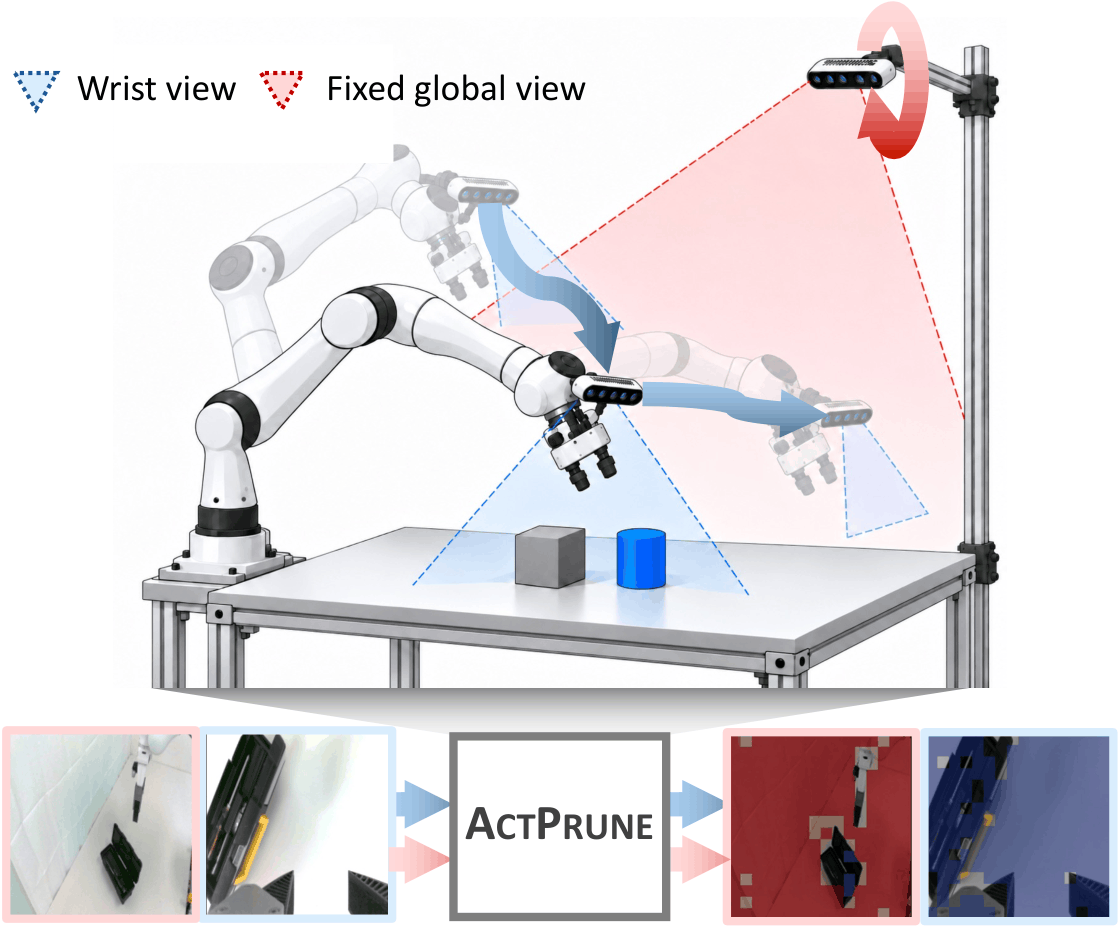
The action is available before the observation
The action chunk predicted at the previous step is available before the current observation is processed in the visual encoder. Unlike visual features or attention scores, it needs no encoding first.
The effect of the action depends on the viewpoint
The redundancy pattern depends on whether the camera moves. A fixed third-person camera sees a static scene where only the manipulator region changes. A wrist camera moves with the end-effector, so the whole image shifts with the action.
Pruning with view-specific geometric priors
Before encoding, ActPrune turns the action into a geometric prior for each view and prunes patches accordingly. After encoding, encoder attention ranks the retained tokens and prunes the rest within the budget.
Method
Before encoding, the previous action guides patch-level pruning in each view. After encoding, encoder attention guides embedding-level pruning of the remaining tokens.
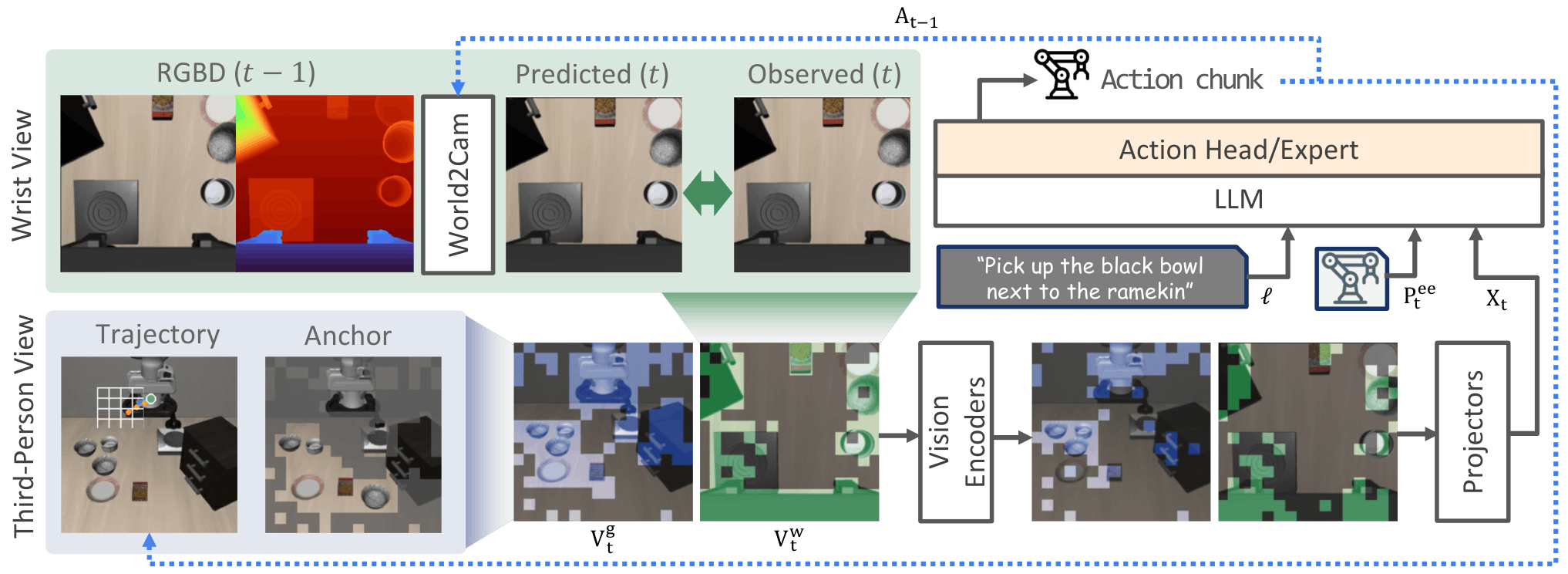
Third-person view: follow the trajectory
The end-effector trajectory from the previous action is projected onto the image plane, and patches around it are retained, with a larger neighborhood when the gripper is closed. Semantic anchors, extracted once per episode, preserve task-relevant regions that remain static.
Wrist view: compensate the camera motion
Patches from the previous observation are reprojected into the current view using the action-induced camera motion and wrist depth. Patches whose features remain unchanged carry no new information, so they are merged into coarse context tokens instead of being encoded.
Rank by attention
After encoding, encoder attention captures the relative importance of patches within the current observation. The retained tokens are ranked by attention and pruned with the remaining budget, so only a small fraction of visual tokens reaches the LLM.
Results
Simulation Experiments
LIBERO results at 50%, 25%, and 12.5% visual token retention. Bold: best, underline: second best within each retention ratio.
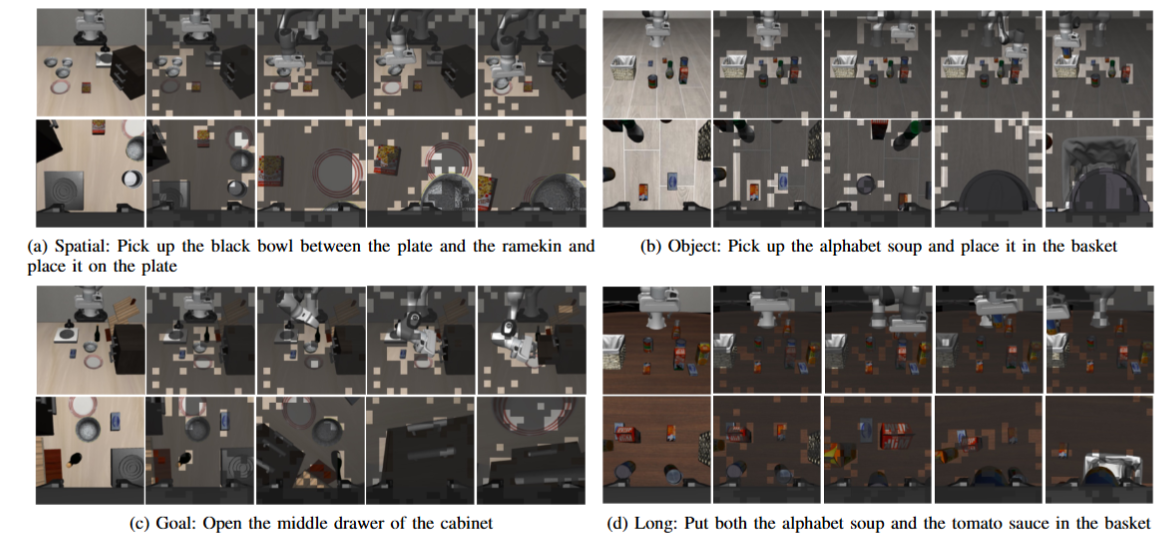
OpenVLA-OFT on LIBERO
| Method | Spatial | Object | Goal | Long | Avg. (%) ↑ | FLOPs (T) ↓ | Latency (ms) ↓ | Speedup ↑ |
|---|---|---|---|---|---|---|---|---|
| OpenVLA-OFT (100%) | 99.0 | 97.0 | 97.4 | 92.6 | 96.5 | 4.739 | 86.17 | 1.00× |
| Retained 50% (50%↓) | ||||||||
| +FastV | 98.6 | 97.6 | 97.2 | 91.2 | 96.2 | 3.123 | 66.19 | 1.30× |
| +SparseVLM | 98.0 | 96.2 | 97.2 | 80.8 | 93.1 | 3.388 | 71.89 | 1.20× |
| +DivPrune | 97.8 | 98.2 | 97.2 | 92.8 | 96.5 | 3.015 | 72.33 | 1.19× |
| +VLA-Cache | 97.0 | 96.2 | 97.1 | 90.6 | 95.2 | 3.509 | 78.72 | 1.09× |
| +VLA-Pruner | 97.6 | 97.4 | 96.4 | 92.6 | 96.0 | 3.025 | 73.49 | 1.17× |
| +SpecPrune-VLA | 95.2 | 98.4 | 97.4 | 48.0 | 84.8 | 3.069 | 72.05 | 1.20× |
| +ActPrune | 98.6 | 98.4 | 97.2 | 93.4 | 96.9 | 2.814 | 65.04 | 1.33× |
| Retained 25% (75%↓) | ||||||||
| +FastV | 98.4 | 97.0 | 96.4 | 89.8 | 95.4 | 2.325 | 54.62 | 1.58× |
| +SparseVLM | 97.8 | 97.2 | 97.6 | 74.4 | 91.8 | 2.666 | 61.74 | 1.40× |
| +DivPrune | 98.6 | 97.8 | 95.4 | 88.8 | 95.2 | 2.172 | 55.23 | 1.56× |
| +VLA-Cache | 98.0 | 86.0 | 95.4 | 79.2 | 89.7 | 2.869 | 63.20 | 1.36× |
| +VLA-Pruner | 98.0 | 97.6 | 97.0 | 89.8 | 95.6 | 2.240 | 63.11 | 1.37× |
| +SpecPrune-VLA | 94.4 | 98.4 | 94.8 | 44.0 | 82.9 | 2.283 | 54.37 | 1.58× |
| +ActPrune | 98.0 | 98.8 | 97.4 | 90.0 | 96.1 | 1.921 | 53.61 | 1.61× |
| Retained 12.5% (87.5%↓) | ||||||||
| +FastV | 98.0 | 90.8 | 94.4 | 64.2 | 86.9 | 1.941 | 52.91 | 1.63× |
| +SparseVLM | 97.2 | 94.6 | 92.6 | 65.6 | 87.5 | 2.340 | 59.94 | 1.44× |
| +DivPrune | 93.6 | 90.0 | 85.6 | 53.0 | 80.6 | 1.750 | 52.51 | 1.64× |
| +VLA-Cache | 92.2 | 88.2 | 92.4 | 56.4 | 82.3 | 2.517 | 59.08 | 1.46× |
| +VLA-Pruner | 96.8 | 95.2 | 91.8 | 68.8 | 88.2 | 1.844 | 65.28 | 1.32× |
| +SpecPrune-VLA | 94.0 | 97.4 | 94.0 | 40.8 | 81.6 | 2.018 | 54.35 | 1.59× |
| +ActPrune | 96.0 | 96.0 | 91.0 | 71.2 | 88.6 | 1.474 | 52.02 | 1.66× |
π0.5 on LIBERO
| Method | Spatial | Object | Goal | Long | Avg. (%) ↑ | FLOPs (T) ↓ | Latency (ms) ↓ | Speedup ↑ |
|---|---|---|---|---|---|---|---|---|
| π0.5 (100%) | 98.0 | 98.0 | 99.4 | 90.8 | 96.6 | 4.975 | 178.3 | 1.00× |
| Retained 50% (50%↓) | ||||||||
| +FastV | 97.4 | 98.6 | 96.2 | 89.6 | 95.5 | 3.952 | 178.1 | 1.00× |
| +SparseVLM | 98.4 | 98.2 | 96.2 | 91.2 | 96.0 | 4.143 | 177.1 | 1.01× |
| +DivPrune | 98.2 | 96.6 | 96.8 | 88.8 | 95.1 | 3.825 | 180.1 | 0.99× |
| +VLA-Cache | 98.0 | 97.0 | 95.2 | 90.2 | 95.1 | 4.091 | 181.4 | 0.98× |
| +VLA-Pruner | 98.0 | 97.8 | 97.0 | 89.0 | 95.5 | 3.895 | 180.3 | 0.99× |
| +ActPrune | 98.0 | 98.4 | 98.4 | 90.6 | 96.4 | 3.695 | 175.5 | 1.02× |
| Retained 25% (75%↓) | ||||||||
| +FastV | 88.4 | 97.8 | 87.0 | 83.6 | 89.2 | 3.447 | 173.8 | 1.03× |
| +SparseVLM | 89.6 | 97.8 | 86.4 | 84.6 | 89.6 | 3.632 | 175.0 | 1.02× |
| +DivPrune | 93.6 | 95.0 | 91.2 | 85.8 | 91.4 | 3.257 | 175.8 | 1.01× |
| +VLA-Cache | 91.0 | 94.8 | 92.0 | 83.0 | 90.2 | 3.781 | 177.4 | 1.01× |
| +VLA-Pruner | 90.4 | 97.6 | 88.8 | 83.4 | 90.1 | 3.357 | 176.6 | 1.01× |
| +ActPrune | 92.0 | 99.0 | 91.4 | 84.6 | 91.8 | 3.063 | 172.9 | 1.03× |
| Retained 12.5% (87.5%↓) | ||||||||
| +FastV | 68.4 | 89.6 | 64.0 | 50.4 | 68.1 | 3.196 | 172.4 | 1.03× |
| +SparseVLM | 67.6 | 85.8 | 63.2 | 54.2 | 67.7 | 3.357 | 173.3 | 1.03× |
| +DivPrune | 72.2 | 87.2 | 70.2 | 58.4 | 72.0 | 2.975 | 175.2 | 1.02× |
| +VLA-Cache | 71.4 | 85.8 | 69.6 | 51.4 | 69.6 | 3.627 | 176.3 | 1.01× |
| +VLA-Pruner | 70.2 | 86.8 | 73.2 | 55.2 | 71.4 | 3.075 | 175.9 | 1.01× |
| +ActPrune | 74.0 | 90.2 | 72.4 | 59.4 | 74.0 | 2.734 | 171.7 | 1.04× |
Real-world Experiments
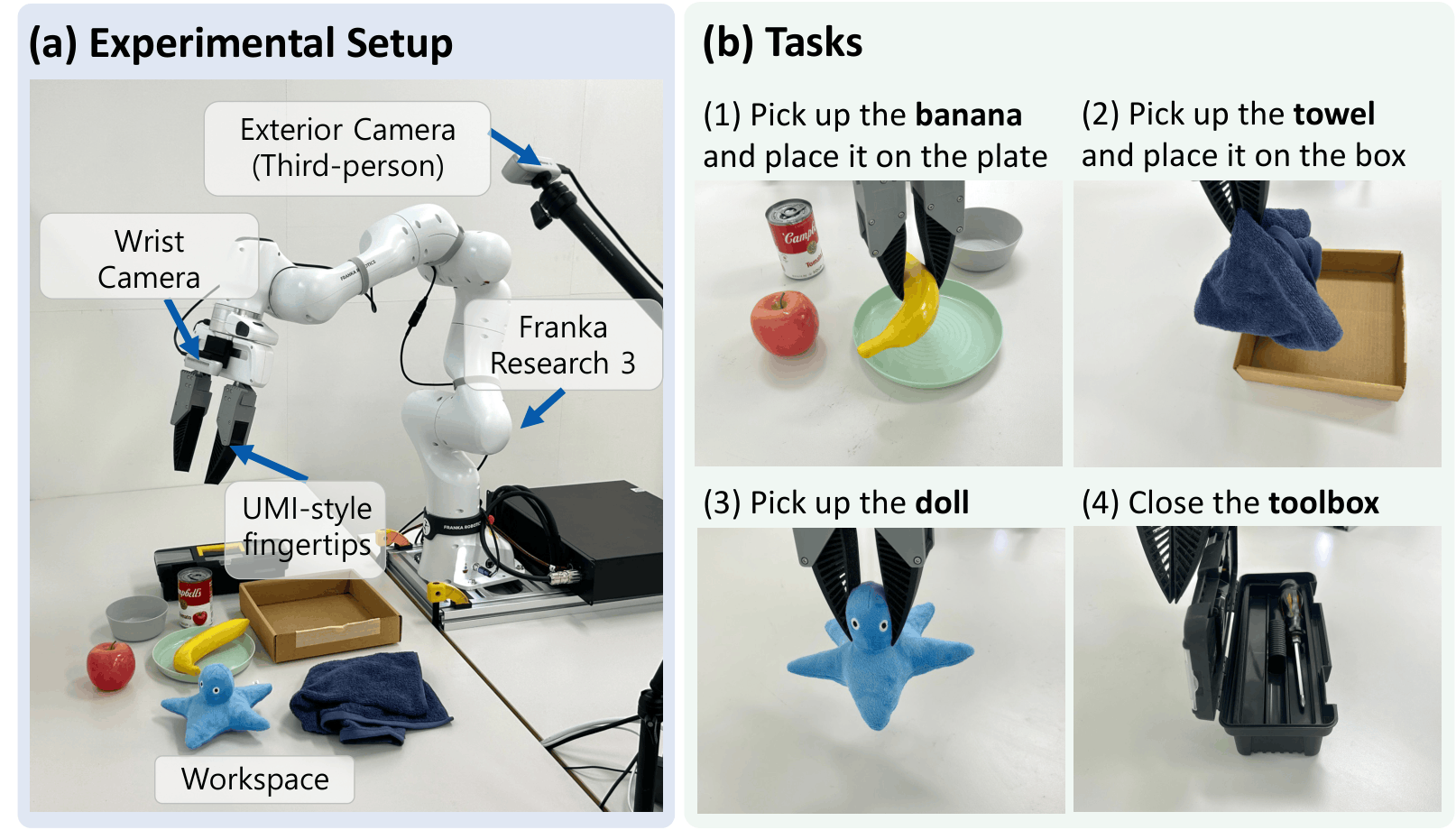
Real-robot results of π0.5 on a 7-DoF Franka Research 3 at 50%, 25%, and 12.5% visual token retention.
| Method | Success (%) ↑ | FLOPs (T) ↓ | Latency (ms) ↓ | |||
|---|---|---|---|---|---|---|
| Tool | Doll | Towel | Banana | |||
| π0.5 (100%) | 70 | 60 | 60 | 50 | 5.021 | 174.8 |
| Retained 50% (50%↓) | ||||||
| +FastV | 60 | 50 | 50 | 30 | 3.996 | 167.6 |
| +SparseVLM | 60 | 50 | 40 | 40 | 4.187 | 169.3 |
| +DivPrune | 60 | 40 | 40 | 20 | 3.869 | 172.3 |
| +VLA-Cache | 50 | 60 | 50 | 30 | 4.036 | 169.7 |
| +VLA-Pruner | 50 | 50 | 50 | 20 | 3.899 | 169.8 |
| +ActPrune | 60 | 60 | 50 | 30 | 3.710 | 166.4 |
| Retained 25% (75%↓) | ||||||
| +FastV | 50 | 40 | 30 | 10 | 3.490 | 163.4 |
| +SparseVLM | 30 | 40 | 30 | 20 | 3.675 | 164.5 |
| +DivPrune | 40 | 30 | 20 | 10 | 3.299 | 163.7 |
| +VLA-Cache | 40 | 50 | 40 | 20 | 3.799 | 168.8 |
| +VLA-Pruner | 40 | 40 | 30 | 10 | 3.400 | 167.5 |
| +ActPrune | 50 | 50 | 40 | 10 | 3.066 | 163.2 |
| Retained 12.5% (87.5%↓) | ||||||
| +FastV | 10 | 20 | 10 | 10 | 3.239 | 159.1 |
| +SparseVLM | 10 | 10 | 0 | 10 | 3.538 | 160.5 |
| +DivPrune | 20 | 10 | 0 | 0 | 3.017 | 159.6 |
| +VLA-Cache | 10 | 20 | 10 | 10 | 3.676 | 162.0 |
| +VLA-Pruner | 10 | 10 | 10 | 0 | 3.117 | 161.4 |
| +ActPrune | 20 | 20 | 10 | 10 | 2.744 | 158.3 |
BibTeX
@article{moon2026actprune,
  title   = {{ActPrune}: Action-Grounded Visual Token Pruning
             for Efficient Vision-Language-Action Models},
  author  = {Moon, Sungwon and Kim, Minji and Boo, Hyemin and
             Song, Daeun and Lee, Jiyoung},
  journal = {arXiv preprint arXiv:2611.08827},
  year    = {2026}
}